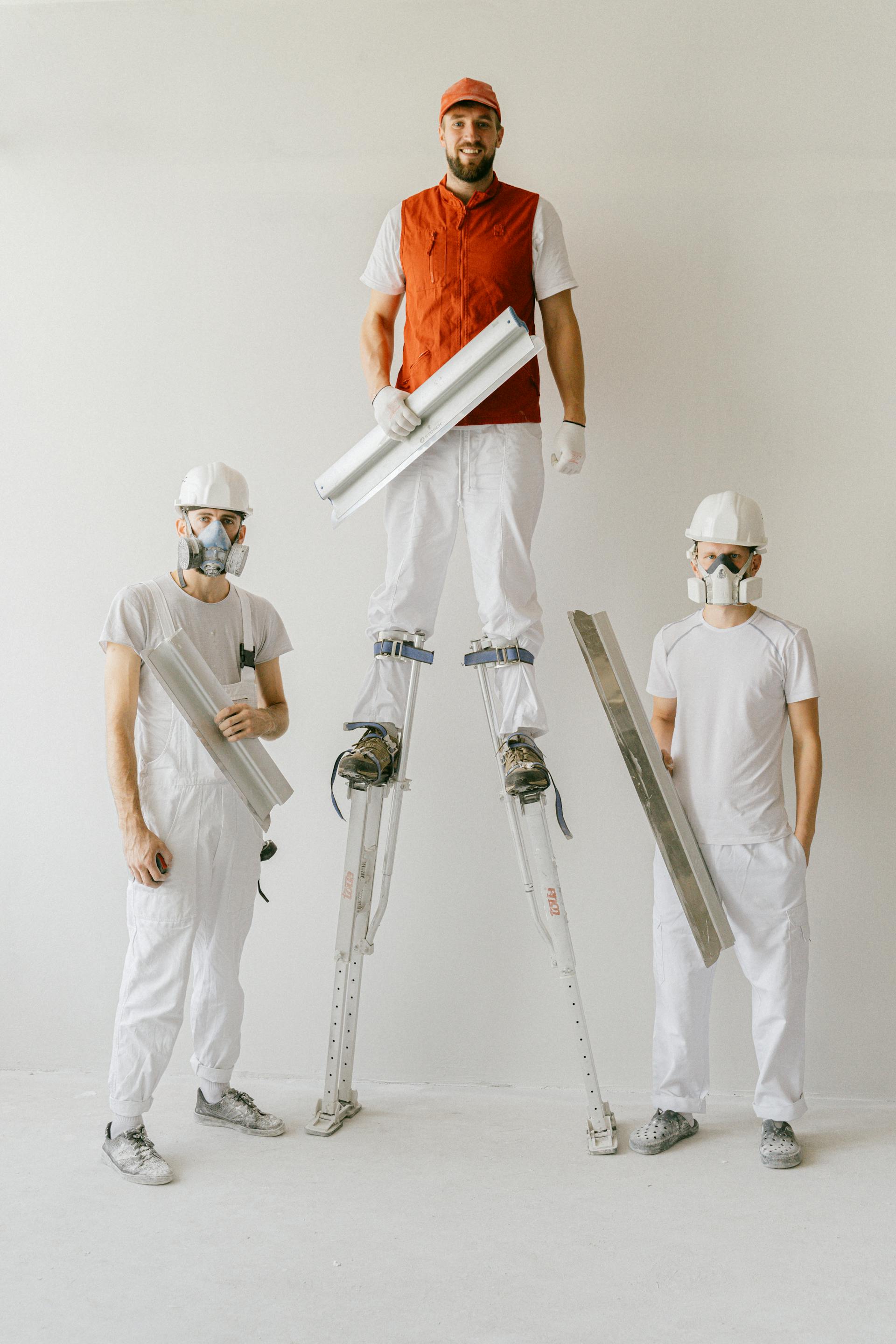
Commercial Drywall Baton Rouge, LA
Commercial drywall in Baton Rouge is a different animal than residential work. The square footage is bigger, sure — but that's the least of it. You're dealing with IBC code requirements instead of IRC, metal stud framing instead of wood, fire-rated assemblies that have to be documented and inspected, and a subtropical climate that will destroy a sloppy installation faster than almost anywhere else in the country. We've watched plenty of out-of-town contractors learn that lesson the hard way on jobs along the Essen Lane corridor or near the Pennington Biomedical Research Center campus. Baton Rouge doesn't forgive shortcuts.
Our crews handle commercial drywall installation across the entire Baton Rouge metro — from tenant buildouts in the Perkins Rowe area to full interior framing packages for medical office construction near Our Lady of the Lake Regional Medical Center and Baton Rouge General. We work in office parks off Siegen Lane, retail strips near the Mall of Louisiana, warehouse conversions in Kleinpeter, and everything in between. If it's a commercial interior, we've almost certainly done something like it within the last few months.
This page covers what commercial drywall actually involves in Baton Rouge — the materials, the code requirements, the climate considerations, and what separates a contractor who knows this market from one who's just filling a bid sheet.
What "Commercial Drywall" Actually Means
The term gets used loosely. Some contractors call any large job "commercial." What we mean by it is more specific: commercial drywall refers to work governed by the International Building Code, typically involving metal stud framing systems, fire-rated Type X or Type C assemblies, acoustic wall configurations, and finish levels that meet the demands of professional environments. It's work that gets inspected, documented, and has to perform over decades of heavy use.
The core components of a commercial drywall scope usually include:
- Metal stud framing (interior non-load-bearing): Cold-formed steel studs and track, typically 20-gauge or 25-gauge for interior partitions, heavier gauge for taller walls or walls requiring additional rigidity. Metal framing is the standard in commercial construction because it's dimensionally stable, non-combustible, and doesn't shrink or warp the way wood does — a real consideration in Baton Rouge's humidity.
- Commercial interior framing and drywall systems: Full partition wall assemblies from floor track to deck or drop ceiling, including backing plates, blocking for wall-mounted equipment, and coordination with mechanical, electrical, and plumbing rough-ins before board goes up.
- Type X fire-rated drywall: 5/8-inch Type X gypsum board is the minimum standard for fire-rated assemblies in commercial occupancies under IBC. One-hour, two-hour, and higher-rated assemblies are built using tested UL designs — specific board types, stud spacing, fastener patterns, and sometimes multiple layers. This isn't something you improvise.
- Tenant improvement drywall: Buildouts for new tenants in existing commercial spaces — reconfiguring open floor plans into private offices, adding conference rooms, constructing demising walls between suites, building out break rooms and restrooms. This is one of the most common scopes we handle.
- Commercial drywall finishing: Taping, floating, and finishing to the level specified by the architect or owner — typically Level 4 for most commercial spaces, Level 5 for high-end offices, lobbies, or spaces with critical lighting.
- Acoustic drywall assemblies: Sound-rated wall and ceiling systems using resilient channels, acoustic sealant, and specific board configurations to achieve STC ratings required for conference rooms, medical offices, and multi-tenant spaces.
- Moisture-resistant drywall installations: Mold-resistant board (purple board or similar) in restrooms, break rooms, and any area with plumbing exposure — a near-mandatory upgrade in Louisiana's climate.
Most commercial projects involve several of these scopes simultaneously. A typical office buildout near the Southern University Campus area might include standard metal stud partitions for open office areas, a two-hour fire-rated assembly for the electrical room, STC-rated walls for the conference suite, cement board in the restrooms, and a Level 5 finish in the reception area. Each of those systems has different material requirements, different installation procedures, and different inspection checkpoints.
Baton Rouge's Climate Makes Commercial Drywall Harder Than Most Places
This is not an exaggeration. Baton Rouge sits in IECC Climate Zone 2A — a hot-humid designation that affects everything from how wall assemblies are designed to how drywall needs to be stored on the job site before installation. The city averages over 60 inches of rainfall annually, and year-round humidity runs between 75 and 90 percent. That's not a seasonal problem. That's the baseline condition every single day.
What that means practically for a commercial drywall contractor in Baton Rouge:
- Board stored on site without climate control will absorb ambient moisture, making it heavier, more prone to sag, and harder to finish cleanly. We stage material delivery to minimize exposure time on every job.
- Joint compound application and drying times are significantly affected by humidity. In July or August, drying between coats takes longer than the bag suggests. Rushing that process produces cracking and tape failures — problems that show up six months after the job is done and the contractor is long gone.
- Exterior-adjacent walls and any wall with plumbing exposure need moisture-resistant board as a baseline, not an upgrade. We specify purple board or equivalent as standard in those locations on every commercial project.
- Climate Zone 2A energy code requirements under Louisiana's adoption of IECC 2015 affect how wall assemblies are built — continuous insulation requirements and vapor retarder placement have to be coordinated with drywall installation. A commercial drywall contractor who doesn't understand that creates code compliance problems that are expensive to fix after the fact.
And then there's hurricane season. June through November, every year. After Hurricane Ida in 2021, we were on commercial job sites across Baton Rouge doing full drywall tear-out and replacement — water-saturated walls in office buildings, retail spaces, and medical facilities. The August 2016 historic flood hit commercial properties in Mid City and low-lying areas along the Amite River corridor especially hard.
Emergency drywall repair in commercial spaces after flood events is something we've handled more times than we'd like to count. It requires a contractor who understands both the remediation side and the rebuild side — including FEMA Substantial Damage rules that can trigger full code compliance upgrades before new drywall can go in.
Code Requirements for Commercial Drywall in Baton Rouge
Louisiana adopted the International Building Code as the foundation of the Louisiana State Uniform Construction Code. For commercial drywall work in Baton Rouge, that means IBC Chapter 25 governs gypsum board and plaster assemblies, and all fire-rated construction has to follow tested UL assembly designs. No improvising, no "we've always done it this way."
A few specific requirements that come up constantly on commercial jobs in East Baton Rouge Parish:
- Building permits: Commercial drywall work tied to tenant improvements, structural modifications, or new construction requires permits through the City-Parish Department of Development. Any renovation exceeding $5,000 in value triggers the permit requirement — and most commercial drywall scopes clear that threshold easily. We pull our own permits. Any contractor who tells you permits aren't needed on a commercial job in Baton Rouge is either wrong or hoping you won't notice.
- LSLBC licensing: The Louisiana State Licensing Board for Contractors requires a state contractor's license for drywall work exceeding $75,000. Commercial projects almost always exceed that threshold. We're licensed. Ask any contractor you're considering to show their LSLBC credentials before you sign anything.
- Fire-rated assemblies: Type X 5/8-inch drywall is the minimum for fire-rated applications under IBC. Specific assemblies — one-hour corridor walls, two-hour shaft walls, fire barriers between occupancies — have to be built to tested UL designs with documented compliance. The Baton Rouge Fire Marshal's office takes this seriously, and inspectors do check.
- Louisiana Lien Law: On commercial projects over $25,000, Louisiana Revised Statute 9:4801 requires contractors to file a Notice of Contract with the East Baton Rouge Parish mortgage office before work begins to protect lien rights. We handle this on every qualifying project. It protects us and it protects the owner.
- Asbestos concerns in older commercial buildings: Commercial buildings constructed before 1980 — and there are plenty of them in Mid City, Old Jefferson, and around the Cortana Mall area — may have joint compound or texture coatings containing asbestos. The Louisiana Department of Environmental Quality enforces abatement requirements before drywall removal in those buildings. We coordinate with licensed abatement contractors when this is a factor.
The regulatory picture for commercial drywall in Baton Rouge is genuinely complex. A commercial drywall company that isn't current on these requirements creates liability for the building owner, not just for themselves.
Tenant Improvement Drywall: The Most Common Commercial Scope in Baton Rouge
The majority of commercial drywall work in Baton Rouge isn't new construction. It's tenant improvements — existing commercial spaces being reconfigured for new occupants or updated for current ones. Office suites along the Essen Lane corridor. Medical office buildouts near the Pennington Biomedical Research Center. Retail spaces in the Perkins Rowe area. Professional service offices in Shenandoah and Sherwood Forest. We've done tenant improvement drywall in all of those markets.
Tenant improvement work has its own set of challenges that differ from ground-up construction. You're working in an occupied or semi-occupied building, often with adjacent tenants still operating. Dust control matters. Noise scheduling matters. Coordination with the building's existing mechanical and electrical systems is tighter because there's less flexibility to move things around. And the timeline pressure is almost always intense — a new tenant has a lease start date and a business that needs to open.
What we tell our customers on tenant improvement projects: the framing and board phase moves fast. The finishing phase is where time gets spent, and where quality either shows or doesn't.
A Level 4 finish done correctly looks clean and professional under normal lighting. Done poorly — rushed coats, inadequate feathering, skipped primer — it photographs badly and looks worse in person. In a professional office environment, that matters to the people who work there every day.
Demising wall construction is a specific element of tenant improvement work that requires attention to both fire rating and acoustics. A demising wall between two commercial suites typically needs to meet both a fire-resistance rating and a minimum STC value — and those two requirements don't always point to the same assembly. Getting that coordination right upfront, before framing starts, is the difference between a wall that passes inspection and one that has to be partially torn out and rebuilt. We've seen that happen on jobs we were called in to fix after another contractor got it wrong. Proper mudding and sealing at penetrations is part of that — acoustic sealant at every outlet box, pipe penetration, and floor/ceiling interface isn't optional on a rated assembly.
The Finishing Side of Commercial Drywall
Framing and hanging board is the visible, fast-moving part of a commercial drywall job. Finishing is where the real craft is, and where the difference between contractors becomes obvious.
Commercial spaces are finished to defined levels — a standardized system developed by the Gypsum Association that runs from Level 0 (no finish, board only) to Level 5 (skim coat over the entire surface). Most commercial tenant improvements are specified at Level 4, which means tape embedded, three coats of joint compound, tool marks and ridges sanded smooth, and surface ready for paint. Level 5 adds a thin skim coat over the entire board face — required in spaces with high-sheen paint, critical lighting angles, or high-end design standards.
Proper sanding between coats is what separates a finish that holds up from one that telegraphs every imperfection once paint goes on. In Baton Rouge's humidity, that also means allowing adequate dry time between coats — something crews under schedule pressure tend to shortcut. We don't. A finish that fails six months after the job is done costs everyone more than taking the extra day to do it right.
Corner bead selection and installation matters more in commercial spaces than most people realize. High-traffic corridors, door frames, and column wraps take abuse. Vinyl bead works fine in low-traffic areas, but metal or paper-faced metal bead holds up better where carts, equipment, and foot traffic create regular impact. We specify bead type by location on every commercial job rather than using one product across the board.
For spaces where texture is part of the design — whether that's a light orange peel in a back-of-house area or a smooth Level 5 in a reception lobby — the application method and product selection have to account for the space's end use. Texture in a commercial kitchen or restroom corridor needs to be cleanable. Texture in a retail space needs to be consistent across large ceiling areas. These aren't decisions to make on the fly.
Commercial Drywall Patching and Repair
Not every commercial drywall job is a full buildout. A significant portion of what we do is patching and repair work in occupied commercial spaces — fixing damage from plumbing leaks, electrical work, HVAC modifications, or just the wear and tear of years of use.
Commercial patching has a matching problem that residential work shares but at larger scale: existing texture, existing paint, and existing finish levels that have to be matched well enough that the repair isn't obvious. In a medical office or law firm, a visible patch on a waiting room wall isn't acceptable. We carry a range of texture products and application equipment specifically for matching existing commercial finishes, and we do test patches before committing to a repair approach on any space where appearance matters.
Fire-rated wall repairs in commercial buildings add another layer of complexity. Any penetration through a fire-rated assembly — whether it was made intentionally for a conduit run or accidentally during a renovation — has to be repaired to restore the original rating. That means using the right board type, the right fastener pattern, and the right joint treatment to match the tested assembly. We document those repairs for the building owner's records.
Who We Serve in the Baton Rouge Commercial Market
Our commercial drywall customers in Baton Rouge include general contractors managing new construction and tenant improvement projects, commercial real estate owners and property managers handling building upgrades and tenant buildouts, healthcare facility operators dealing with ongoing renovation in occupied medical environments, and business owners managing their own buildout projects directly.
Each of those customer types has different priorities. A GC wants a subcontractor who shows up on schedule, coordinates cleanly with other trades, and doesn't create problems that slow the job down. A property manager wants a contractor who can work around tenants, communicate clearly, and deliver a finish that makes the space rentable. A business owner wants someone who explains what they're doing and why, hits the budget, and gets out of the way so the business can open.
We work with all of them. The approach adjusts. The quality standard doesn't.
We also serve commercial customers in the surrounding communities — including Gonzales, Denham Springs, and Zachary — where commercial development has been active and the same IBC standards and climate considerations apply.
Getting a Commercial Drywall Estimate in Baton Rouge
Commercial drywall bids aren't something we generate from a square footage formula. Every job gets a site visit, a review of the plans if they exist, and a scope breakdown that covers materials, labor, and any special requirements — fire ratings, acoustic assemblies, moisture-resistant installations, finish levels. We don't quote a number and figure out the details later.
If you have plans, send them over before the site visit so we can come prepared with questions. If you don't have plans yet — if you're still in the design phase — we can give you a preliminary range based on the scope description and refine it once drawings are available. We've worked with enough Baton Rouge commercial projects to give you a realistic number early in the process.
Call or use the contact form to set up a site visit. We'll tell you what we see, what it's going to take, and what it's going to cost — straight, without padding the scope to protect a low number.
Last updated: