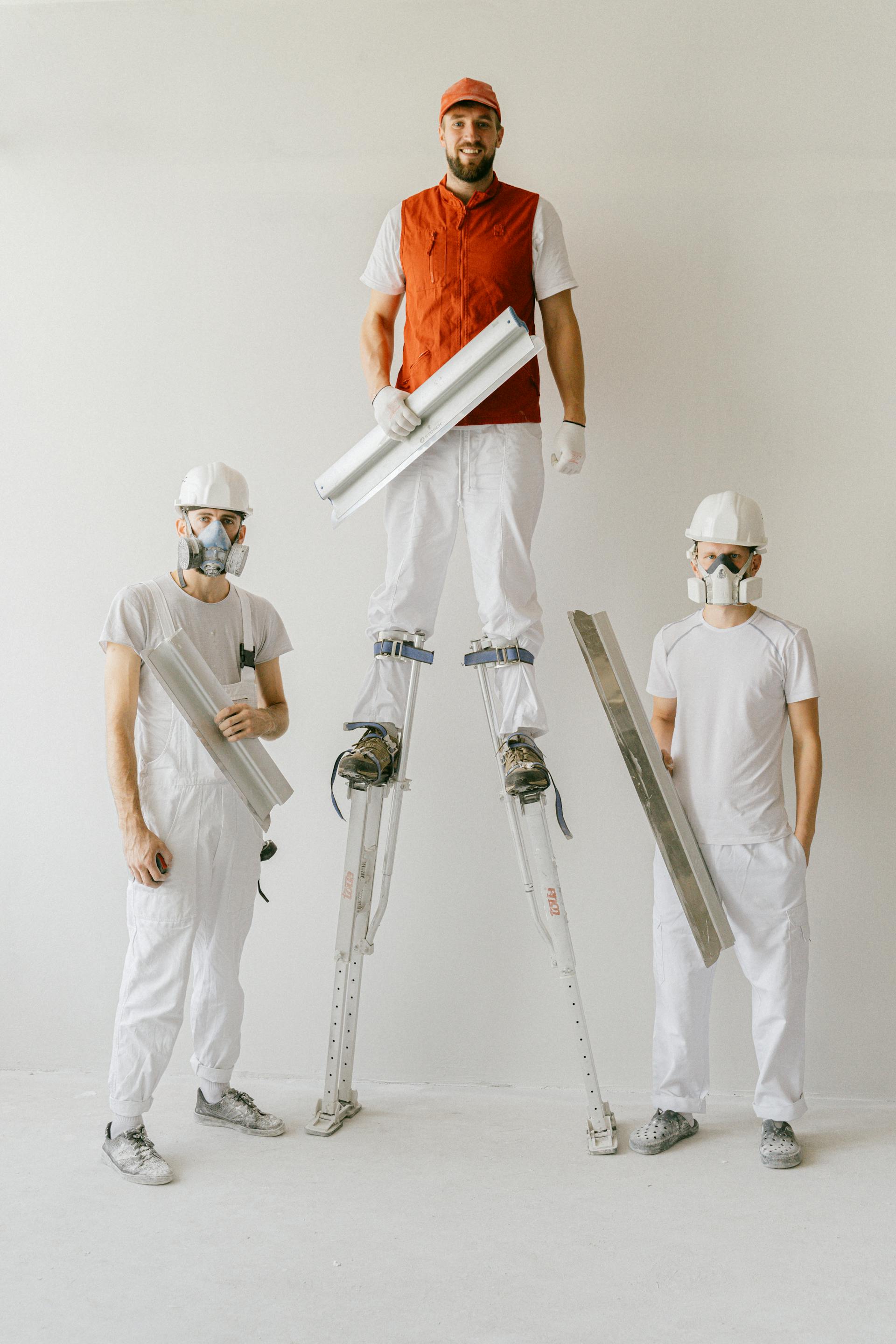
Drywall Taping Baton Rouge, LA
The tape is where it all shows. You can hang perfectly level sheets, hit every stud, space your screws exactly right — and then the tape job goes sideways, and suddenly you've got ridges telegraphing through your paint, bubbles lifting off the wall six months later, and seams that look like someone drew a map across your living room ceiling. In Baton Rouge, bad taping doesn't just look rough. It fails. Faster than you'd expect, and usually at the worst possible time.
We've been doing drywall work in Baton Rouge long enough to know that this city is genuinely one of the harder environments in the country to do this work correctly. The humidity here isn't a seasonal inconvenience — it's a year-round adversary. Average relative humidity sitting above 75% means joint compound takes longer to cure, tape adhesion is compromised if you rush it, and any shortcut in the finishing process will eventually surface. Literally. The homes in Mid City, the renovated doubles in the Garden District, the newer construction out in Shenandoah and Kleinpeter — every one of them presents the same challenge: tape and mud that has to hold up against conditions that would embarrass a contractor from a drier climate.
And then there's what happens after a storm. The August 2016 flood damaged over 110,000 homes across the Baton Rouge metro. Hurricane Ida in 2021 tore through the region and left behind a wave of drywall replacement work that kept crews busy for the better part of two years. We've personally walked through homes in Broadmoor and Old Jefferson where the waterline was still visible on the studs, where every sheet from the floor up four feet had to come out, and where the taping job on the replacement drywall had to be done right — because the homeowner had already been through enough.
This page covers what professional drywall taping in East Baton Rouge Parish actually involves: the process, why it matters more here than in most other parts of the country, what separates a quality tape-and-mud job from one that'll be peeling by next summer, and what to look for when you're hiring a taping contractor.
What Drywall Taping Actually Involves
A lot of homeowners think taping is just slapping some paper over a seam and calling it done. It's not. Done correctly, drywall joint taping is a multi-stage process that requires the right materials, the right sequence, and enough time between coats to let the compound cure properly — which, in Baton Rouge's humidity, means you can't rush it without paying for it later.
Here's how a proper taping and finishing job breaks down:
- Embedding coat (first coat): Joint compound is applied over every seam, screw dimple, and corner. Paper tape or fiberglass mesh tape is pressed into the wet compound over flat seams. This coat isn't about looking good — it's about adhesion. The tape has to be fully embedded with no air pockets, no dry spots, no lifting edges. In high-humidity conditions like we deal with across Baton Rouge, this coat needs adequate cure time before you move on. Rushing it is one of the most common reasons tape bubbles and peels.
- Second coat (fill coat): Once the embedding coat is fully dry, a second, wider coat of joint compound goes on. This is where you start building out the feathered edge — blending the compound smoothly away from the seam so it disappears into the surrounding drywall. Butt joints, where two factory ends meet without a tapered edge, require extra attention here because there's no natural recess to work with.
- Third coat (finish coat): The final coat is applied with a wider knife — often a 10- or 12-inch blade — and feathered out even further. This is the coat that determines how the wall looks under paint. Any ridges, tool marks, or uneven edges left here will show up the moment light hits the wall at an angle.
- Sanding and inspection: After the finish coat cures, the surface is sanded smooth, wiped down, and inspected under raking light to catch any imperfections before primer goes on. Skipping this step — or doing it carelessly — is how you end up with a paint job that looks worse than the bare drywall did.
Corner bead taping gets its own attention. Metal or vinyl corner bead is installed on outside corners first, then taped and mudded to create a straight, durable edge. Inside corners get paper tape folded into a crease and embedded carefully — one of the trickier spots to get right, because any excess compound on one plane will create a ridge on the other.
Paper Tape vs. Mesh Tape in a Climate Like Baton Rouge's
This is a conversation we have regularly with customers, and the answer matters more in South Louisiana than it does almost anywhere else.
Fiberglass mesh tape has become popular because it's easy to work with — it's self-adhesive, it goes on fast, and you don't have to embed it into a wet coat the same way you do with paper. But mesh tape has a real weakness: it's not as strong under stress. In a market where foundation settling is common — particularly in the clay-heavy soils along the Mississippi River floodplain that underlie neighborhoods from Tara to University Hills — walls move. Seams shift. Fiberglass mesh tape, under that kind of cyclical stress, is more prone to cracking than paper tape properly embedded in setting-type compound.
Paper tape, applied correctly, creates a stronger bond. It's the professional standard for flat seams in most applications, and in our experience it holds up better over time in homes that deal with the seasonal movement Baton Rouge houses are known for. That said, moisture-resistant drywall tape — specifically products designed to resist humidity-driven peeling that's endemic in South Louisiana — is worth discussing on any project near bathrooms, kitchens, or exterior walls.
For areas that are genuinely flood-prone — homes near the Amite River corridor, properties in Special Flood Hazard Areas where East Baton Rouge Parish now requires flood-damage-resistant materials following the updated floodplain ordinances after 2016 — fiberglass-faced or paperless drywall combined with the appropriate tape and compound system is the right call. Paper facing on drywall in a flood zone is a mold problem waiting to happen.
Levels of Finish: What You Actually Need
The drywall finishing industry uses a standardized system — Levels 0 through 5 — to define how complete a taping and finishing job is. Most homeowners in Baton Rouge don't know this system exists, and that's fine. But it matters when you're getting quotes, because not every contractor is pricing the same scope of work.
- Level 0: No finishing at all. Used in temporary construction or spaces that'll be demoed anyway.
- Level 1: Tape embedded in compound at joints and angles, no finishing. Typical for attic spaces and areas that won't be seen.
- Level 2: One coat over tape and fasteners, smooth enough for tile or heavy texture. Common in garages and utility spaces.
- Level 3: Two coats, lightly sanded. Used under heavy wall texture. Not appropriate for smooth or flat paint finishes.
- Level 4: Three coats, sanded smooth. The standard for most painted interior walls in residential construction — what most homeowners in Sherwood Forest, Bocage, and similar neighborhoods are getting, or should be getting.
- Level 5: Three coats plus a skim coat of compound over the entire surface. The highest standard, required for flat or eggshell paint in high-light areas. If you've got a room with a lot of natural light, or you're going with a flat finish, Level 5 is the only finish that won't embarrass you.
If you're painting with flat or matte paint — common in higher-end Baton Rouge homes — budget for Level 5. Flat paint is brutally unforgiving. Every imperfection in the tape and mud work shows up under that finish in a way it wouldn't under satin or semi-gloss. The extra cost of a proper skim coat is always less than repainting because the walls look worse finished than they did bare.
Why Baton Rouge's Climate Makes Taping Harder
Sixty-plus inches of rain per year. Humidity that rarely drops below 70% even in the cooler months. Afternoon thunderstorms from March through October that drive water under rooflines and around window frames. This is the environment your drywall tape is living in, and it demands a different level of care than you'd find in Dallas or Atlanta.
Tape peeling due to humidity is one of the most common service calls we get across the parish. It happens when the embedding coat wasn't given enough time to cure before the next coat went on, when the wrong compound was used in a high-moisture area, or when the drywall wasn't properly primed and moisture migrated through the wall assembly and attacked the tape bond from behind. All of these are preventable. None of them are cheap to fix after the fact — which is why fixing drywall problems in Baton Rouge so often traces back to a taping job that was rushed the first time around.
Tape bubbling — that telltale blister under the surface — is almost always an adhesion failure from the first coat. Either the compound was too thin, the tape wasn't pressed in firmly enough, or there was a dry spot beneath it. In a humid climate, any gap between tape and compound becomes a moisture trap. Moisture gets in, the paper swells, the bond breaks, and the bubble appears. By the time you can see it, the failure has usually spread further than it looks.
Hot summers compound the problem differently. When temperatures push past 95°F — which happens regularly from June through August, from the LSU campus area all the way out to Denham Springs — joint compound can skin over on the surface while remaining wet underneath. That's called case-hardening, and it leads to shrinkage cracks and poor adhesion on subsequent coats. Experienced taping crews know how to manage drying conditions: working in sections, keeping the work area conditioned, timing coats to the actual cure rather than the clock.
Post-Flood Drywall Taping: What the Remediation Process Looks Like
Baton Rouge has lived through enough major flood events that post-flood work is genuinely a core part of what drywall contractors here do. The 2016 flood. Ida. The repeated flooding along Ward Creek and the Comite River that hits Broadmoor and surrounding areas with frustrating regularity. After water comes out of a home, the drywall work isn't just about aesthetics — it's about doing it right so the mold problem doesn't come back.
Post-flood drywall taping in East Baton Rouge Parish typically follows a specific sequence. Damaged drywall is demoed — usually cut at four feet, sometimes higher depending on the waterline — and the framing is allowed to fully dry, treated for mold, and inspected before any new drywall goes in. In Special Flood Hazard Areas, the updated parish floodplain ordinances now require flood-damage-resistant materials, which means paperless or fiberglass-faced drywall on the lowest floor of affected structures. That changes the taping equation slightly, because some standard joint compounds don't adhere as well to fiberglass-faced board as they do to paper-faced.
Once the new drywall is hung, the taping process follows the same multi-coat sequence — but with extra attention paid to the horizontal seam where new drywall meets existing. That transition line is a weak point. If it's not taped and feathered correctly, it'll show through paint and remind the homeowner of the flood every time the light catches the wall at the wrong angle. That's not acceptable work, and it's not how we approach it.
If you're starting from scratch after a flood event, the taping work is just one piece of a larger project. The drywall installation side of flood remediation — board selection, hanging, blocking — has to be done right before any taping begins. Rushing the hang to get to the finish is how you create problems that no amount of good taping can fix.
What to Look for When Hiring a Drywall Taping Contractor in Baton Rouge
Not every crew that hangs drywall tapes well. And not every crew that tapes well understands how to manage the specific conditions in South Louisiana. Here's what actually matters when you're vetting someone for this work.
Ask how they handle humidity and drying conditions. A contractor who gives you a blank look or says they just follow the label on the compound bucket isn't thinking about this carefully enough. Experienced crews in this market know when to slow down, when to use setting-type compound instead of drying-type, and when conditions require adjusting the schedule.
Ask what finish level they're quoting. If a contractor gives you a price without specifying the finish level, you don't have a real quote. Level 3 and Level 5 are not the same job. The difference in labor and material cost is significant, and the difference in outcome under paint is dramatic.
Ask about their tape and compound selection. In a market with Baton Rouge's moisture profile, the choice of tape type and compound formulation isn't arbitrary. A contractor who uses the same materials regardless of location, wall type, or moisture exposure isn't paying attention to the details that matter here.
Look at finished work under raking light before you commit. Ask to see a completed project — not photos, but an actual room — and bring a flashlight. Hold it at a low angle to the wall and look for ridges, seam lines, and tool marks. That's how paint will reveal the work. If it looks rough under a flashlight before paint, it'll look rough under paint after.
Good taping work is invisible. You shouldn't be able to find the seams. You shouldn't see ridges or shadows. The wall should look like one continuous surface. That's the standard we hold ourselves to on every job, whether it's a single room repair or a full house after a flood.
For a broader look at what we do across East Baton Rouge Parish, visit our main Baton Rouge drywall services page. If you've got existing damage — cracks, holes, tape that's already failing — our drywall repair services cover the full range of fixes, from small patches to full section replacement.
Last updated: